PRODUCT:
Helping Ticketmaster clients find answers faster and self-serve with confidence.
ROLE:
Product Designer & UX Researcher
TIMELINE:
Aug 2023 - Oct 2025
CONTEXT:
Led design strategy and execution for an enterprise support platform, partnering cross-functionally to increase client adoption, improve self-service outcomes, and reduce reliance on human support.
TOOLS:







Introduction
PROJECT OVERVIEW:
Ticketmaster’s B2B support platform was initially developed to provide clients with on-demand help and training during the COVID-19 period. As usage grew beyond its original scope, the platform presented an opportunity to be refined and scaled into a more reliable, self-service experience.
This project focused on evolving the platform to better support ongoing client needs by improving structure, clarity, and ease of use, enabling clients to find answers faster and rely less on direct support.
Role & Scope
Sole product designer responsible for the end-to-end experience of a global enterprise support platform, spanning navigation, content structure, search, research, and measurement.
I partnered closely with PMs, engineers, data, and marketing to improve self-service clarity and scale support across global markets.
Key areas of ownership:
Platform interface and navigation redesign
End-to-end support flows (homepage, search, guides, forms)
Content standards and article structure
Search improvements (prompts, metadata, synonyms)
Qualitative and quantitative research
Defining and tracking success metrics
Confidentiality
Due to confidentiality agreements, I cannot publicly disclose details of my work. Please contact me directly for more information about this role.
Business Goal
Ticketmaster needed to increase successful self-service so clients could resolve routine issues independently and reduce overall support volume.
User Needs
Event operations is complex and highly-technical. Clients struggled to quickly find the answers they needed on the support platform due to fragmented content and unclear navigation, leading to confusion, slower resolution, and frequent escalation to contacting a support agent.
👉 The Challenge: How might we empower clients to resolve issues independently through the Support Community, reducing the need to contact a support specialist for routine problems?
Design Principles
Clarity over completeness — prioritize the clearest path to resolution
Systems over screens — design frameworks that scale across content and features
Measure what matters — define success through self-service outcomes, not surface-level engagement
The Solution
SOLUTION FOCUS:
Navigation, content systems, and search as the foundation for scalable self-service.
I owned design decisions end-to-end, from defining success metrics and information architecture to validating solutions through research and data. To address fragmented knowledge and complex client workflows, I led design strategy and execution for the Support Community.
NAVIGATION & STRUCTURE:
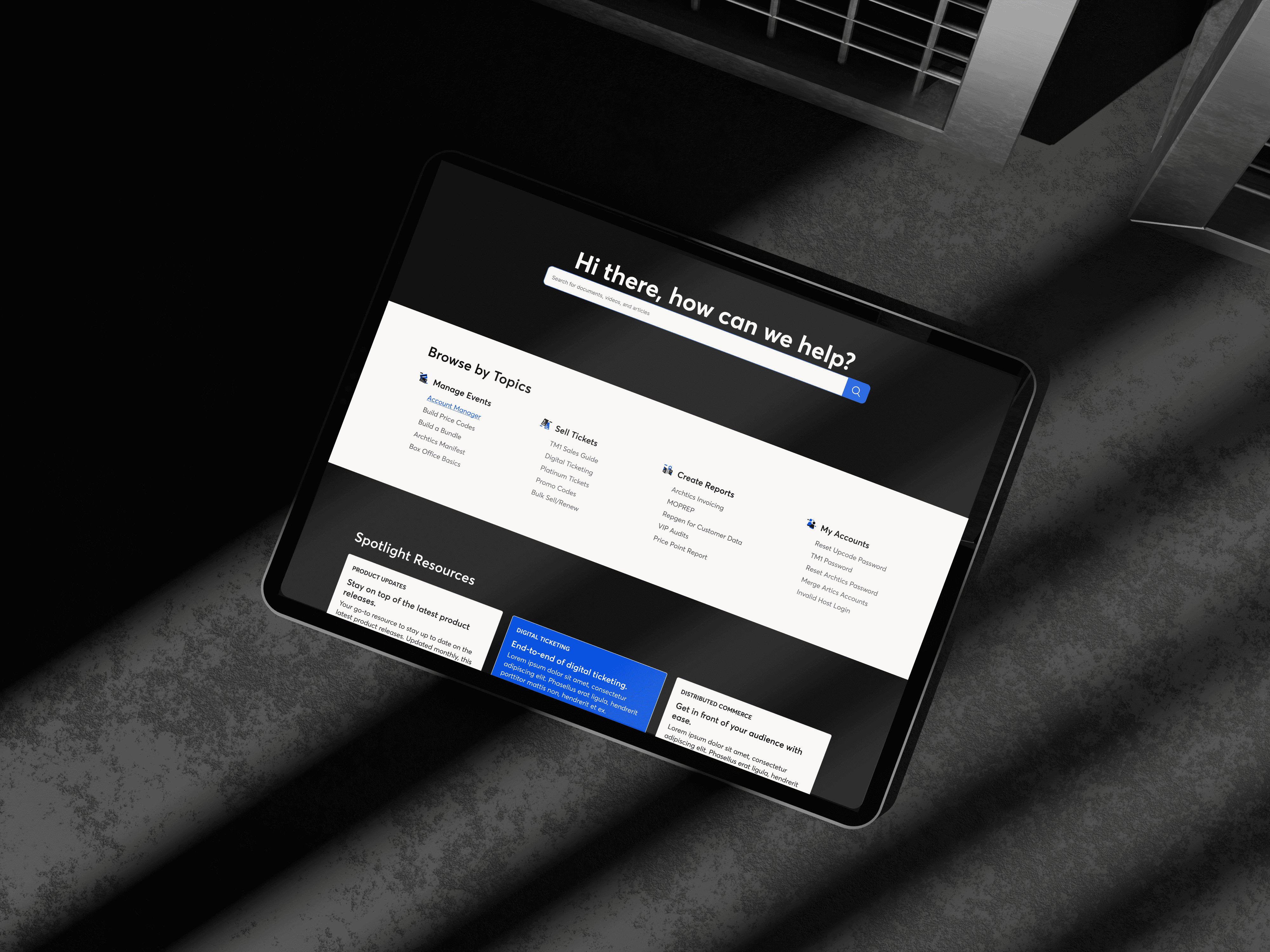
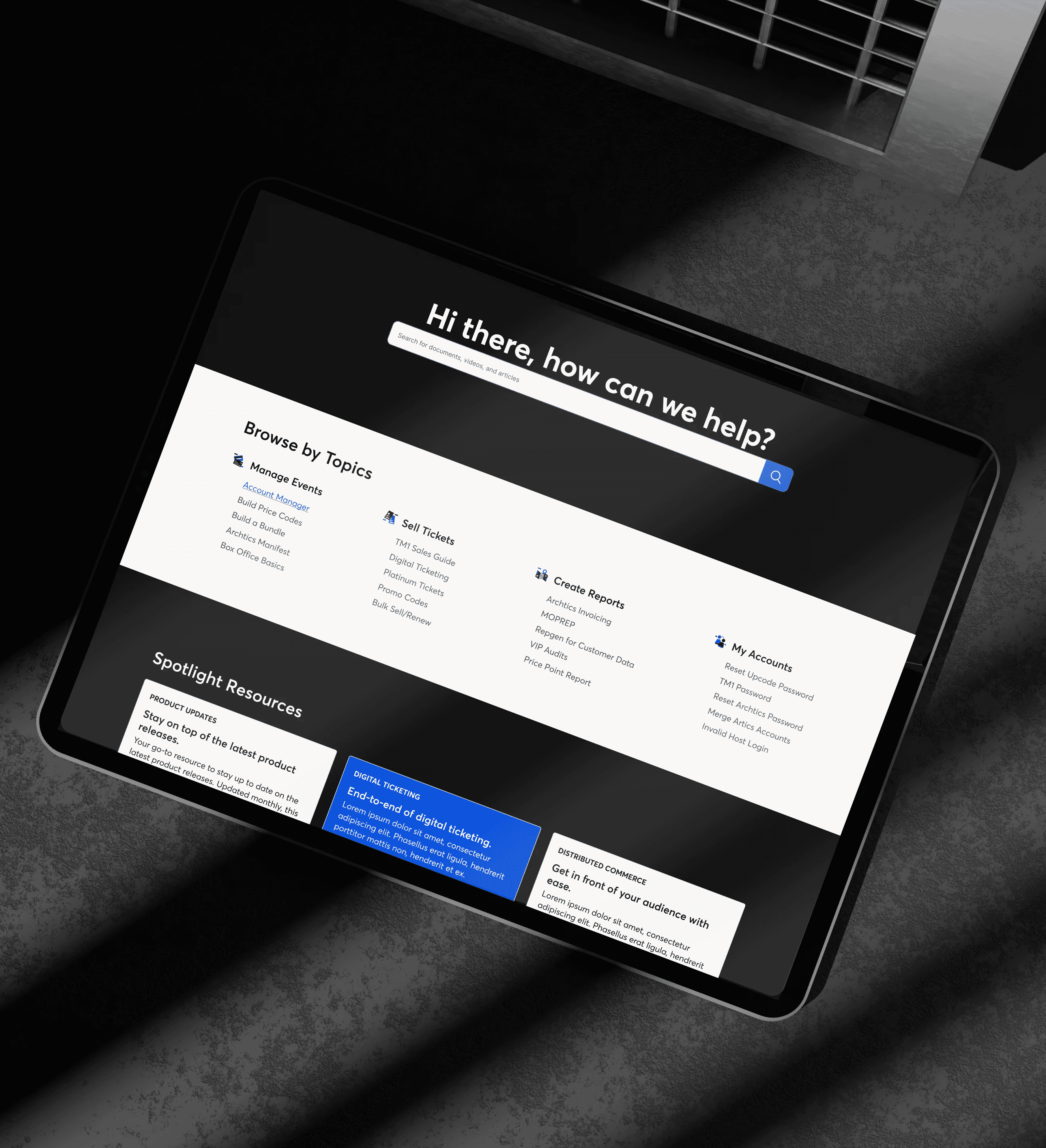
I redesigned the centralized navigation around task- and process-based journeys to better reflect how clients move through event operations.
CONTENT SYSTEMS:
In parallel, I refreshed the article style guide to standardize how product education content is created and maintained, ensuring consistency and scalability across teams.
SEARCH & FINDABILITY:
To further improve findability, I partnered with data to enhance search through AI- and ML-driven improvements, including prompts, metadata, and synonym mapping—creating a clearer, more intuitive self-service experience.
Impact
Self-Service Support at Scale
I redesigned the Support Community to help clients find answers faster and resolve issues on their own with confidence. By clarifying navigation, standardizing content, and improving search, the platform became easier to use without needing to escalate to human support.
Success was reflected in stronger engagement with self-service resources, higher self-resolution, and fewer drop-offs before contacting support. These improvements allowed support teams to operate more efficiently while delivering a consistent, on-demand experience across global markets.
Takeaways
Prioritizing the MVP over the “perfect” vision
This project reinforced the importance of shipping solutions that address the core problem first, rather than over-designing for an ideal future state. I learned how to scope thoughtfully, make pragmatic design decisions, and sequence work so the product could improve iteratively while still delivering immediate value to clients.
Design that scales
Designing for an enterprise platform required thinking beyond individual features and toward systems that could scale across products, teams, and global markets. I focused on foundational improvements—such as flexible navigation models, reusable patterns, and content frameworks—that support a growing and diverse client base while maintaining clarity, consistency, and ease of use as the platform evolved.